
If you put three data architects in a room and ask them how to design a warehouse, you won’t get a blueprint. You’ll get a brawl.
For decades, our industry was stuck in a cold war between two philosophies: the Bill Inmon loyalists and the Ralph Kimball pragmatists. Just when we thought the dust had settled, Data Vault entered the chat, promising to solve the problems neither of the old guard could quite fix.
As data engineers, we usually don’t get to pick our religion—we inherit it. We join a company, look at the DAGs, and realize, “Oh, so we’re doing Star Schema… sort of.”
To survive (and fix the mess), you need to understand not just what these models are, but why people fight over them. Here is the plain-English breakdown.
1. Bill Inmon: The "Single Source of Truth"
The Vibe: Strict, organized, and academic.
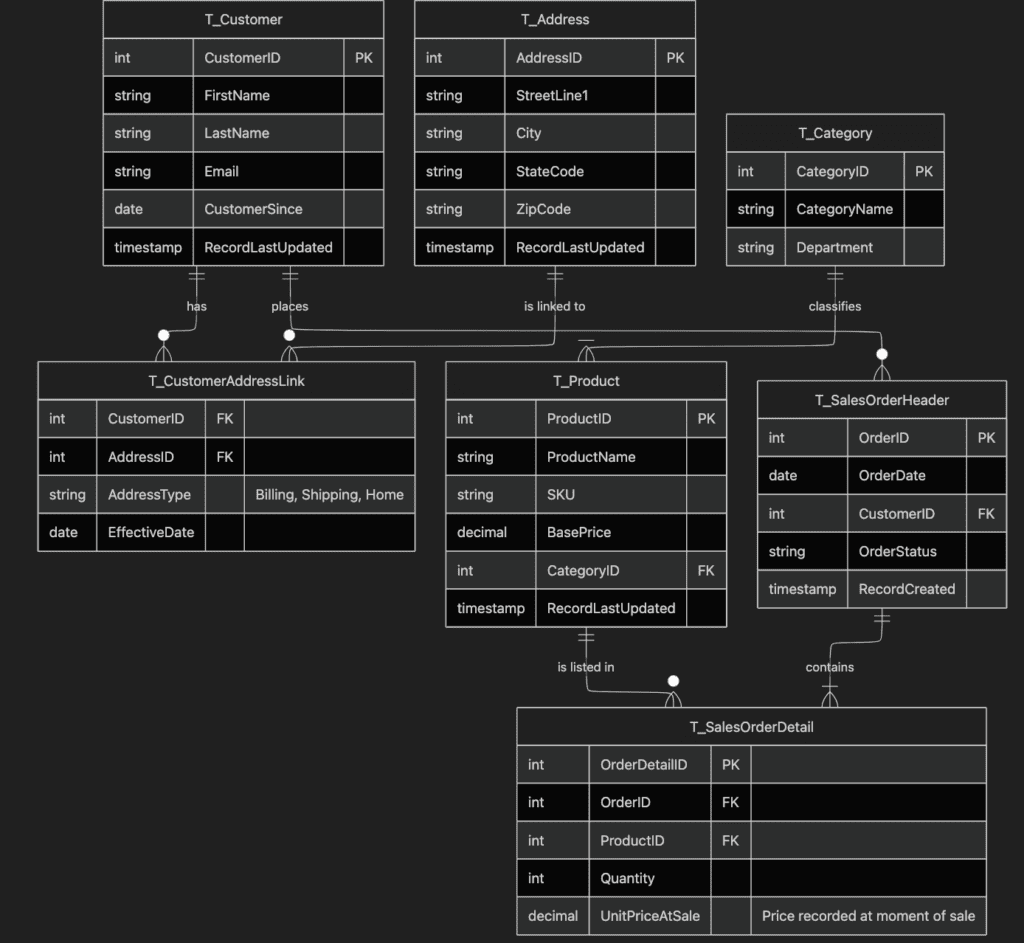
Think of Inmon’s approach (the Corporate Information Factory) like a public library. Everything has a specific place. If you want a book on “Physics,” it’s in the 500s. If you want “History,” it’s in the 900s. There are strict rules about how books are shelved so that no matter who walks in, the system makes sense.
In Inmon’s world, you normalize everything (3rd Normal Form). You don’t store “Customer Address” inside the “Orders” table because that’s redundant. You store it in a customer table, and you link to it.
- Why we love it: It’s clean. There is exactly one place to update a record. If a customer moves, you change their address in one spot, and the whole warehouse sees it.
- Why we hate it: It’s slow to build and painful to query. To answer a simple question like “How many widgets did we sell in Q4?”, you might have to join 12 different tables.
2. Ralph Kimball: The "Get It Done" Guy
The Vibe: Fast, user-friendly, and practical.
If Inmon is a library, Kimball is a newsstand. You don’t care about the Dewey Decimal System; you just want to grab the sports section and leave.
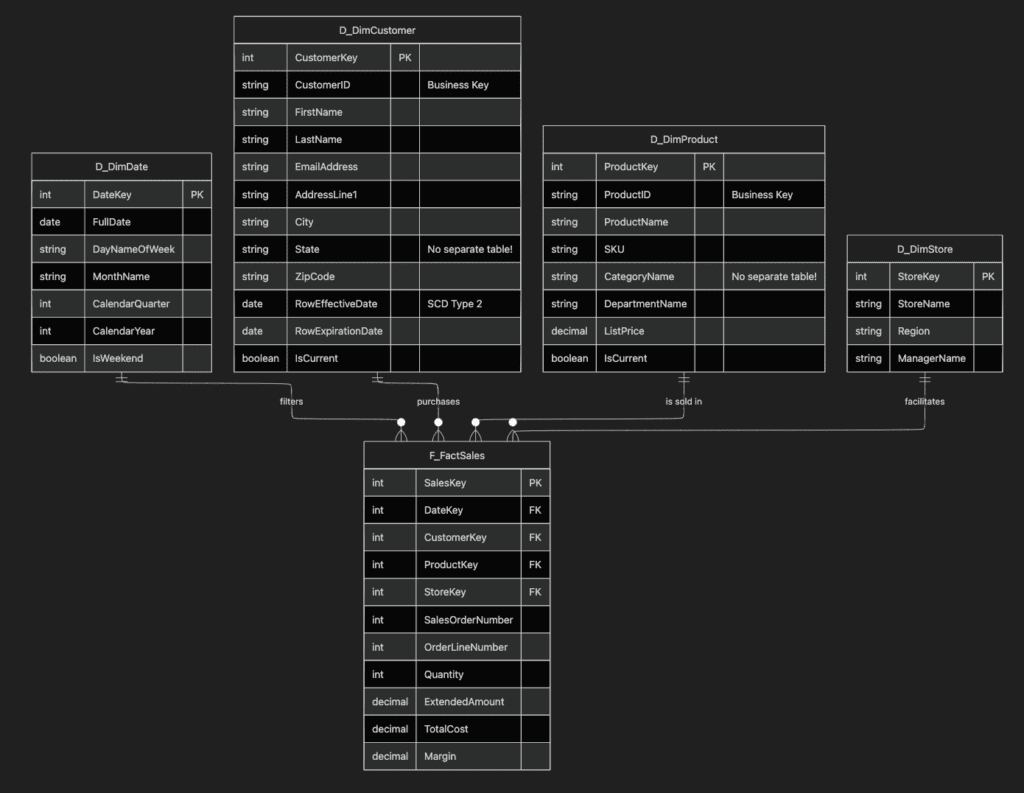
Kimball’s approach (Dimensional Modeling) is all about speed. He argued that business users—the people paying our salaries—don’t know SQL. They can’t do 12 joins. So, we should build star schemas.
You have a big table in the middle called a Fact (the events: sales, clicks, page views), and you surround it with Dimensions (the context: who, what, where, when).
- Why we love it: Performance. Queries fly because the data is denormalized (pre-joined, effectively). It’s also intuitive; a business analyst can look at a star schema and immediately understand how to write a report.
- Why we hate it: Maintaining history is a nightmare. If a customer changes their name, you technically have to update that string in every single historical sales record if you haven’t set up your “Slowly Changing Dimensions” perfectly.
3. Data Vault 2.0: The Agile Hoarder
The Vibe: Paranoid, flexible, and audit-obsessed.
Data Vault, created by Dan Linstedt, looked at Inmon and Kimball and said, “You guys are assuming the business rules won’t change. They always change.”
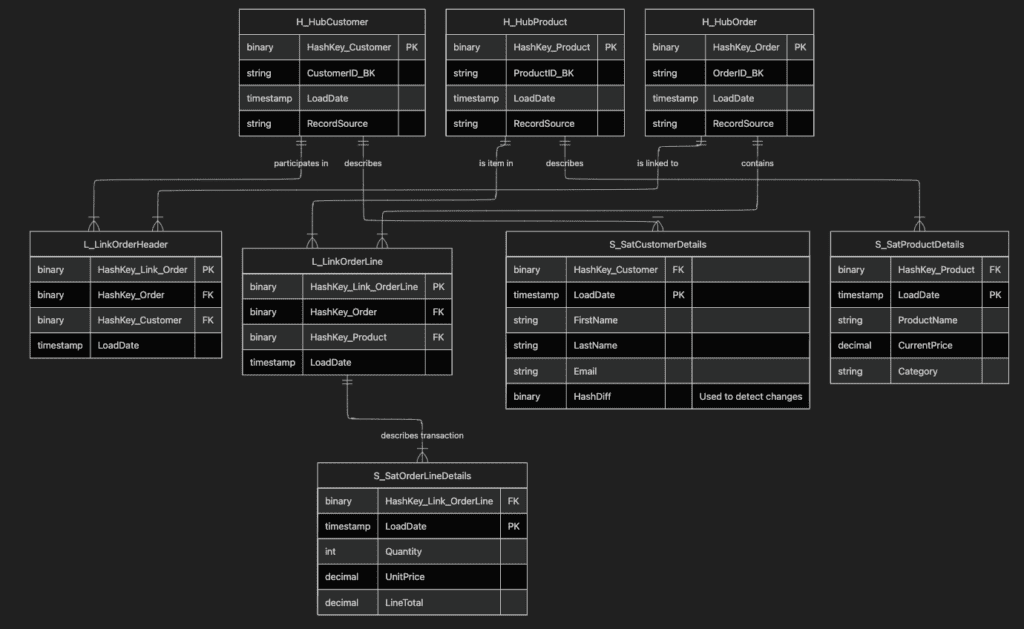
Data Vault is built for the modern era of auditing. It separates the keys (hubs), the relationships (links), and the data (satellites).
The golden rule of Data Vault is we never delete. We just insert new rows. If a customer changes their address, we don’t overwrite the old one (like Inmon) or wrestle with complex updates (like Kimball). We just insert a new row in a “Satellite” table with a new timestamp.
- Why we love it: It’s bulletproof. You can trace the history of every single data point back to the source. It also handles “schema drift” beautifully—if a source system adds a column, you just add a new satellite. You don’t break the existing model.
- Why we hate it: The query complexity is insane. To get a usable table, you often have to join a hub to a link, then to another hub, then to two satellites. You essentially need a tool like dbt to manage the SQL for you.
The Verdict: Just Use All of Them
Here is the secret that textbooks won’t tell you: Nobody follows these rules 100%.
In a modern data stack (think Snowflake, BigQuery, Databricks), we tend to mash them together into a “Medallion” architecture:
- Bronze (Raw): Just dump the data. Don’t touch it.
- Silver (Clean): This is often where Data Vault shines. We clean the data and store the history here so we never lose anything.
- Gold (Presentation): This is pure Kimball. We take that complex Data Vault/Silver data and transform it into nice, clean star schemas so the marketing team’s dashboards load in 2 seconds.
So, don’t worry about picking the “winning” side. The best engineers are the ones who know which tool to pull out of the toolbox.
About Me
I hope my stories are helpful to you.
For data engineering post, you can also subscribe to my new articles or becomes a referred Medium member that also gets full access to stories on Medium.


